Fill The Voids Under Concrete Before They Spread
Epp Foundation Repair has filled soil voids and stabilized slabs with polyurethane foam across Nebraska, Iowa, Kansas, and Missouri since 1994. A clean, light material that fills the gap and is ready to use the same day.

Let's take the first step toward a healthy home.
A local specialist will inspect your foundation, walk you through the findings, and send a clear estimate. no cost, no pressure.
What polyurethane foam void filling is and when it's the right call.
Polyurethane foam void filling works by turning a liquid into a lightweight solid right where the gap is. The foam starts as two liquid components that mix at the injection gun. The moment they combine, a chemical reaction starts and the mixture expands many times its liquid volume in seconds, then cures to a firm, closed-cell plastic in minutes. Crews drill small holes, often around a half inch to five-eighths of an inch across, through the slab in a planned pattern, then inject the foam through a port. The expanding foam flows into the void under the slab, fills every irregular pocket, and presses outward against the soil and the underside of the concrete. Because this is mid-soil injection in the top few feet, the foam works in the fill directly beneath the slab and reaches a maximum of roughly 4 feet, so it is matched to flatwork voids rather than deep soil problems. The reason voids form here is regional. In eastern Nebraska and Iowa, water from downspouts, irrigation, and 50 to 70 freeze-thaw cycles a year erodes fine soil from under slab edges, and expansive clay shrinks as much as 10 to 15 percent in volume when it dries through summer, pulling away from the slab. Foam fills the resulting gap and, because the cured foam is closed-cell, it resists water and will not wash out or break down like uncompacted soil. The other advantage is weight. Cured foam weighs far less than the cement-based slurry used in traditional mud jacking, so it adds very little load to soil that is already weak, which makes it a smart choice when the underlying ground is soft. The expansion pressure can also nudge a settled slab back toward level, so the crew watches the slab against a laser or string line and controls injection to stabilize first and recover elevation where the slab allows. The holes are small, the foam sets in minutes, and the slab is typically ready for normal use the same day, including vehicle traffic on a driveway.
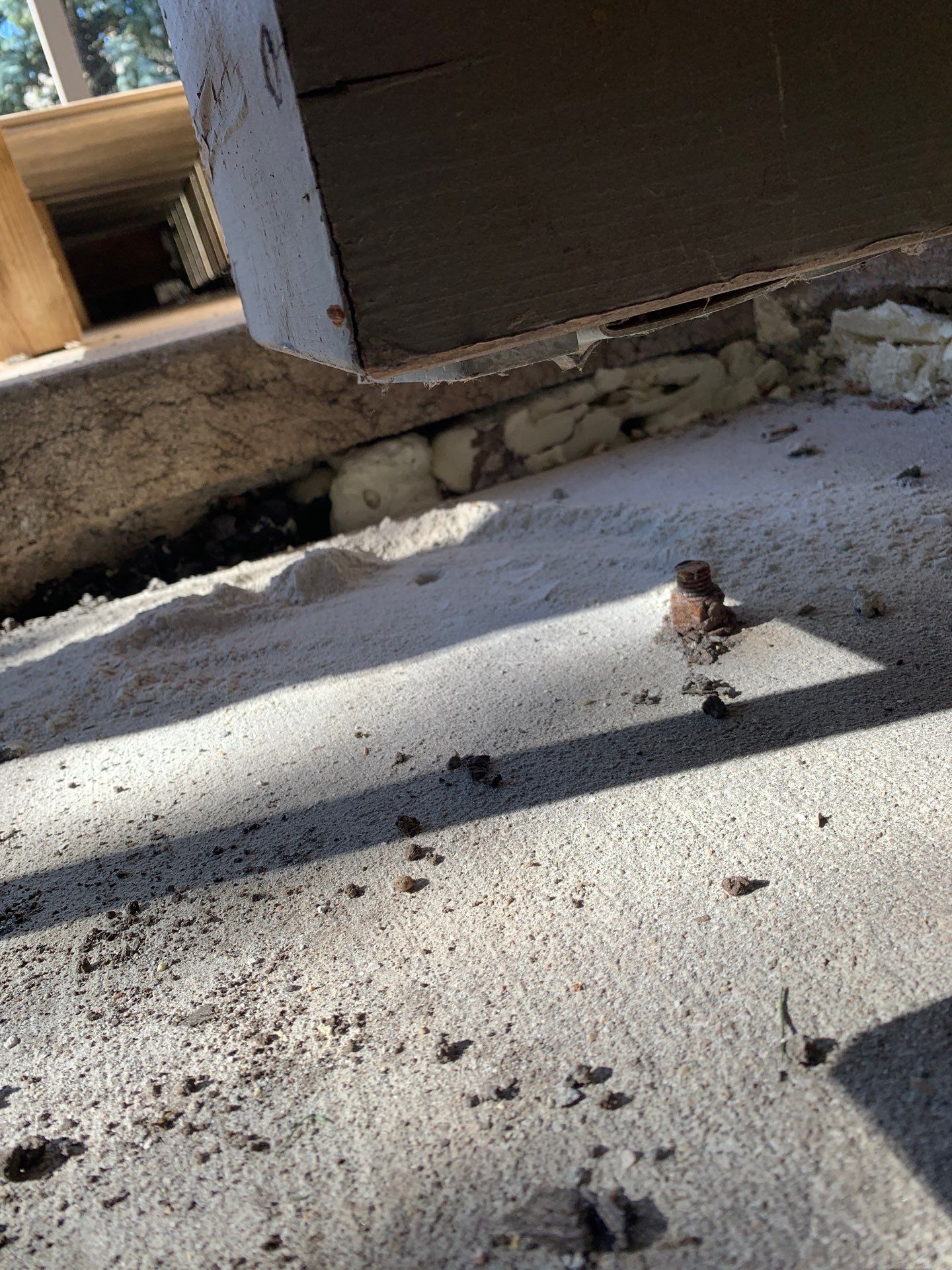
How we install polyurethane foam void filling.
Void Inspection and Hole Layout
Epp Foundation Repair finds where the slab has lost support, checks the cause such as a leaking downspout or eroded edge soil, and confirms the slab is sound enough to save. The crew marks a pattern of small injection holes positioned to reach the full void beneath the panel, and explains whether foam or another method fits best.
Drilling and Foam Injection
Small holes, often around a half inch across, are drilled through the slab. The two-part polyurethane is injected through a port; it expands within seconds to fill the void and press against the soil and the underside of the slab. Because foam reaches a maximum of about 4 feet, it treats the fill directly beneath the concrete.
Controlled Stabilization and Lift Attempt
The crew controls injection while watching the slab against a laser or string line. The foam first fills and supports, and its expansion can nudge the slab back toward level, so the crew works in stages to stabilize and recover elevation where the slab allows, stopping before any overlift or cracking.
Hole Patching and Same-Day Use
The small holes are patched to blend with the slab. Because the foam cures in minutes, the slab is usually ready for normal use the same day, including vehicle traffic on a driveway. The crew reviews the result and points out any drainage issue to correct so the void does not return.
"Foam is my pick when the soil's soft or the access is tight. It's light, it fills every pocket the water carved out, and you can drive on the slab the same afternoon. Just fix the downspout that caused the void."

Care and expertise from a team that's been doing this since 1994.
Epp Foundation Repair is locally owned and operated, with crews dedicated exclusively to foundation, basement, and concrete work across the Midwest.
Foundation repair, waterproofing, and concrete leveling are our entire focus. not a sideline.
Three decades of experience with Midwest soils, basements, and weather conditions.
Recognized in 2011 and 2016 for ethical business practices and customer transparency.
Most product solutions carry 10 to 25-year warranties backed by the original installer.

Answers to common questions about Polyurethane Foam Void Filling.
Don't see your question here? Our team is happy to help. Reach out anytime.
Other foundation repair solutions we install.
Every solution is engineered for a specific soil profile and failure mode. Browse the full toolkit.
Carbon Fiber Reinforcement
Epp Foundation Repair has reinforced bowed walls across Nebraska, Iowa, Kansas, and Missouri since 1994. No interior steel, no excavation, no lost basement space.
Learn moreDeep Foundation Systems
Epp Foundation Repair has stabilized settling structures across Nebraska, Iowa, Kansas, and Missouri since 1994 by carrying the load past weak surface soil to firm ground below. Stop the settlement, then attempt to recover what you can.
Learn moreEpoxy Crack Injection
Epp Foundation Repair has injected foundation cracks across Nebraska, Iowa, Kansas, and Missouri since 1994, and uses sequential polyurethane plus epoxy when one alone won't hold.
Learn moreExpansion Joints
Epp Foundation Repair has placed and resealed expansion joints across Nebraska, Iowa, Kansas, and Missouri since 1994. A good joint gives concrete room to move so it cracks where you want it to, not where you don't.
Learn moreFoundation Underpinning
Epp Foundation Repair has driven engineered piers through Nebraska loess and Kansas clay since 1994. Helical, push, and slab piers, matched to the soil and the structure.
Learn moreHelical Deck Piers
Epp Foundation Repair has set helical deck piers across Nebraska, Iowa, Kansas, and Missouri since 1994. Steel screwed into firm ground holds a deck level through every freeze-thaw season.
Learn moreServing Nebraska, Iowa, Kansas & Missouri.
Local crews based in six regional offices, dispatched daily across four states. If your town isn't listed, call us. we likely serve your area.
- Omaha, NE
- Lincoln, NE
- Des Moines, IA
- Ankeny, IA
- Topeka, KS
- Urbandale, IA
- Sioux City, IA
- West Des Moines, IA
- Bellevue, NE
- St. Joseph, MO
Take the first step toward a healthy home.
A straightforward path from initial inspection to completed repairs.
Schedule your inspection.
A local specialist visits your home, evaluates the foundation, and answers your questions on site. No cost, no obligation.
Receive an estimate based on your needs.
We provide a clear, written estimate with a scope of work tailored to your home's specific issues. Typically within one business day.
Get your repairs.
Our certified crews complete the work on schedule and back it with product warranties of up to 25 years.
Over 1,750 homeowners have shared their experience.
A 4.9-star average across Google, with verified reviews from homeowners throughout Nebraska, Iowa, Kansas, and Missouri.
Two ways to start: book instantly, or request an estimate.
Schedule your inspection in seconds with our Driive booking tool, or share a few details and a local specialist will follow up within one business day.
- A local foundation specialist on site
- A complete walk-through of the findings
- A written estimate within one business day
- No cost, no obligation, no high-pressure sales
Expert guidance on protecting your home.
Practical articles from the Epp team on foundation health, waterproofing, and home preservation.
 foundation-repairFeatured
Why foundation problems are common in Des Moines homes.
Iowa's expansive clay soils and freeze-thaw cycles are particularly hard on residential foundations. A practical guide to what's happening below grade and why local…