Transfer Your Home's Weight To Soil That Holds
Epp Foundation Repair has stabilized settling structures across Nebraska, Iowa, Kansas, and Missouri since 1994 by carrying the load past weak surface soil to firm ground below. Stop the settlement, then attempt to recover what you can.
Let's take the first step toward a healthy home.
A local specialist will inspect your foundation, walk you through the findings, and send a clear estimate. no cost, no pressure.
What deep foundation systems is and when it's the right call.
Deep foundation systems work by skipping the soil that failed and finding soil that won't. A typical house foundation sits on a shallow footing a few feet down, which is fine until the soil under that footing moves. In eastern Nebraska and western Iowa the usual culprit is expansive clay or loess that swells when saturated after spring rain and snowmelt, then shrinks as much as 10 to 15 percent when it dries through summer. That cycle repeats with the 50 to 70 freeze-thaw events the region sees most years, and over time the footing loses uniform support and the structure settles unevenly. A deep foundation reaches past this active zone. A steel push pier is a sectional steel tube hydraulically driven straight down through the weak soil, one section at a time, using the weight of the house itself as the reaction force. The pier keeps going until it hits soil dense enough to resist the drive, often well below the frost line, which in this region runs about 36 to 42 inches deep. A helical pier is a steel shaft with one or more helix plates welded near the tip; hydraulic equipment turns it into the ground like a screw, and the plates bear against firm soil to carry the load. Because helicals develop capacity from torque as they install, the crew can verify the holding capacity of each pier as it goes in, which is useful in variable soil. Once the piers reach capacity, the crew transfers the structure's weight onto them through steel brackets bolted to the footing. At that point the load path runs from the house, through the brackets, down the steel, to firm ground. The settling soil at the surface is no longer holding the building. With the load on the piers, the crew can carefully apply hydraulic pressure to attempt lift, recovering some of the lost elevation where the structure and soil allow. The system stays in place permanently and the steel is galvanized to resist corrosion underground.
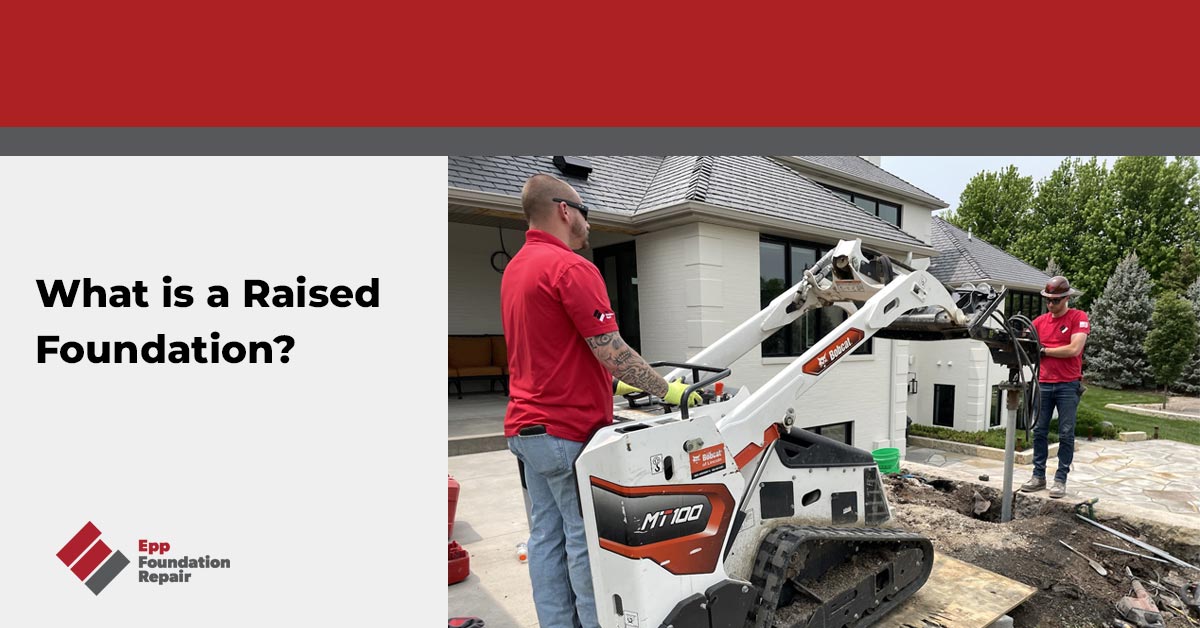
How we install deep foundation systems.
Inspection and Load Calculation
Epp Foundation Repair measures the settlement, maps the cracks, and identifies which sections of the structure have lost support. The specialist calculates the load each pier must carry and the likely depth to firm soil, then decides whether push piers, helical piers, or a mix fits your structure and soil. You receive a Customized Repair Estimate with the plan, not a generic quote.
Excavation and Bracket Placement
The crew digs access points down to the footing at each planned pier location and attaches a heavy steel bracket to the footing. The bracket is the connection that will eventually carry the structure's weight onto the pier, so it is seated against sound concrete and positioned to transfer load cleanly.
Driving or Screwing the Piers to Capacity
Push piers are hydraulically driven in sections until they reach load-bearing soil and meet the required resistance; helical piers are turned into the ground until torque readings confirm capacity. Each pier is taken to a verified depth and holding force before the next step, so the support is documented rather than assumed.
Load Transfer and Lift Attempt
With the piers at capacity, the crew transfers the structure's weight onto them through the brackets. They then apply controlled hydraulic pressure to attempt lift toward the original elevation, recovering what the soil and structure allow. Access excavations are backfilled and the site is restored.
"A deep system is the right call when the footing is settling and the soil quit holding. But I check the cause first. If it's really drainage or a slab void, piers are the wrong tool and I'll say so."

Care and expertise from a team that's been doing this since 1994.
Epp Foundation Repair is locally owned and operated, with crews dedicated exclusively to foundation, basement, and concrete work across the Midwest.
Foundation repair, waterproofing, and concrete leveling are our entire focus. not a sideline.
Three decades of experience with Midwest soils, basements, and weather conditions.
Recognized in 2011 and 2016 for ethical business practices and customer transparency.
Most product solutions carry 10 to 25-year warranties backed by the original installer.

Answers to common questions about Deep Foundation Systems.
Don't see your question here? Our team is happy to help. Reach out anytime.
Other foundation repair solutions we install.
Every solution is engineered for a specific soil profile and failure mode. Browse the full toolkit.
Carbon Fiber Reinforcement
Epp Foundation Repair has reinforced bowed walls across Nebraska, Iowa, Kansas, and Missouri since 1994. No interior steel, no excavation, no lost basement space.
Learn moreEpoxy Crack Injection
Epp Foundation Repair has injected foundation cracks across Nebraska, Iowa, Kansas, and Missouri since 1994, and uses sequential polyurethane plus epoxy when one alone won't hold.
Learn moreExpansion Joints
Epp Foundation Repair has placed and resealed expansion joints across Nebraska, Iowa, Kansas, and Missouri since 1994. A good joint gives concrete room to move so it cracks where you want it to, not where you don't.
Learn moreFoundation Underpinning
Epp Foundation Repair has driven engineered piers through Nebraska loess and Kansas clay since 1994. Helical, push, and slab piers, matched to the soil and the structure.
Learn moreHelical Deck Piers
Epp Foundation Repair has set helical deck piers across Nebraska, Iowa, Kansas, and Missouri since 1994. Steel screwed into firm ground holds a deck level through every freeze-thaw season.
Learn moreHelical Piers
When a foundation has settled into soft or eroding soil, surface-level repairs treat the symptom. Helical piers transfer the structure's load to deep bearing soil, stopping settlement permanently, often restoring lost elevation.
Learn moreServing Nebraska, Iowa, Kansas & Missouri.
Local crews based in six regional offices, dispatched daily across four states. If your town isn't listed, call us. we likely serve your area.
- Omaha, NE
- Lincoln, NE
- Des Moines, IA
- Ankeny, IA
- Topeka, KS
- Urbandale, IA
- Sioux City, IA
- West Des Moines, IA
- Bellevue, NE
- St. Joseph, MO
Take the first step toward a healthy home.
A straightforward path from initial inspection to completed repairs.
Schedule your inspection.
A local specialist visits your home, evaluates the foundation, and answers your questions on site. No cost, no obligation.
Receive an estimate based on your needs.
We provide a clear, written estimate with a scope of work tailored to your home's specific issues. Typically within one business day.
Get your repairs.
Our certified crews complete the work on schedule and back it with product warranties of up to 25 years.
Over 1,750 homeowners have shared their experience.
A 4.9-star average across Google, with verified reviews from homeowners throughout Nebraska, Iowa, Kansas, and Missouri.
Two ways to start: book instantly, or request an estimate.
Schedule your inspection in seconds with our Driive booking tool, or share a few details and a local specialist will follow up within one business day.
- A local foundation specialist on site
- A complete walk-through of the findings
- A written estimate within one business day
- No cost, no obligation, no high-pressure sales
Expert guidance on protecting your home.
Practical articles from the Epp team on foundation health, waterproofing, and home preservation.
 foundation-repairFeatured
Why foundation problems are common in Des Moines homes.
Iowa's expansive clay soils and freeze-thaw cycles are particularly hard on residential foundations. A practical guide to what's happening below grade and why local…